NOSYMMETRIES / 2025-26 - DEMOCRACY?
July 2025 - March 2026
IDENSITAT + La Capella Centre d'Art (Barcelona)
NOSYMMETRIES is an artistic research project exploring the intersection of the concepts of social inequality, violence, and care. These issues, fueled by politics based upon threats and fear, accelerated by contemporary capitalism, directly impact upon rights, identity, gender, race, and class.
INTRODUCTION
PROGRAM
WORKING GROUP
OPEN CALL
INTRODUCTION
The project focuses on critical imagination and social creativity from diverse perspectives which challenge artistic and cultural practices linked to social justice and the degradation of democratic values.
Since 2024, Idensitat, as part of the Concentric programme at La Capella Centre d'Art, has deployed artistic practices impacting on social and cultural contexts. For the years 2025-2026 Idensitat is proposing the formation of a working group composed of seven people, selected by a public call. The group will set up an artistic investigation aimed at producing a personal or a collaborative project, combining research, production, and the socialisation of processes. Nosymmetries has been conceived as a space for sharing methodologies and knowledge, and for implementing ideas which address the degradation of transcultural diversity, the loss of rights, and the neocolonisation of democratic values.
During July, September, October, and December 2025, and January 2026, monthly meetings will be held with invited guests. These sessions will combine presentations, workshops, and group activities which aim to share experiences and knowledge, as well as supporting participants in defining their individual or collective proposal. Once the scheduled sessions have been finalised, the resulting productions will be presented in a collective exhibition open at La Capella Centre d'Art in March 2026.
PROGRAM
SESSION SCHEDULE
July 14th and 15th - Workshop with Marwa Arsanios
September 9th and 16th - Working group session
October 14th and 28th - Working group session + guest session with Núria Güell
October 29th - presentation of the process (open house)
November 18th - Working group session
December 2nd and 19th - Working group session + guest session with Adrian Schindler
January 20th and 21st - Workshop with Ana Teixeira Pinto
Marwa Arsanios - Who is Afraid of Ideology?
Monday the 14th and Tuesday 15th of July
To kick off the programme, artist, filmmaker and researcher Marwa Arsanios (Beirut-Berlin) has been invited to lead a workshop and public talk, sharing her line of artistic research.
The Workshop on the 14th and the 15th of July was for participants of the NOSYMMETRIES’ working group and it departed from a set of literary and filmic material that is thinking through the possibility of a different relationship to land than the one of private property. Where do we find the commons today? In which practices of assembling, collective land tenure etc... We will discuss excerpts of texts and watch certain film scenes that helped us think through questions of communalisation, collectivisation, non-property and more. The aim was to gather a small tool box of communalisation.
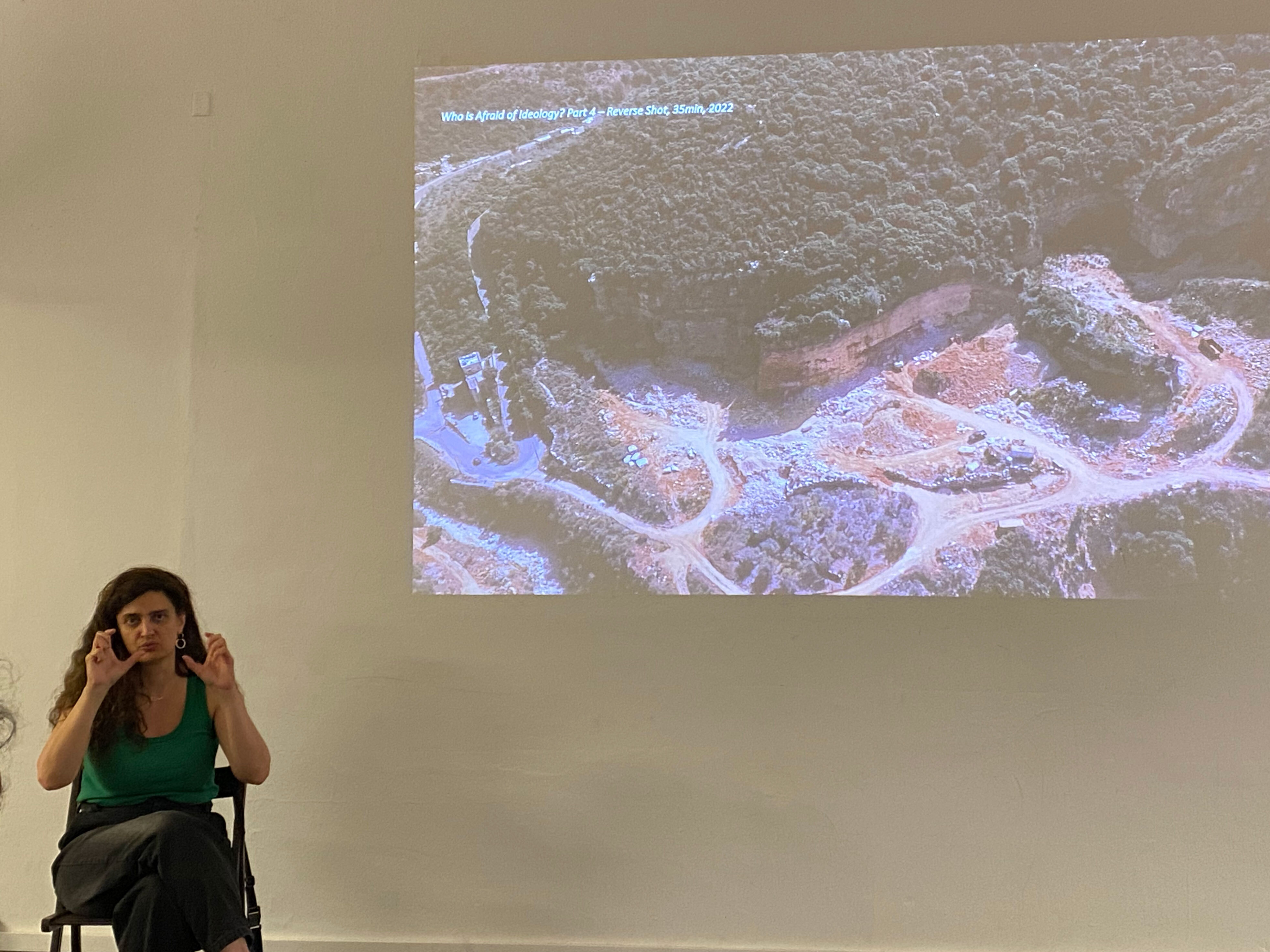
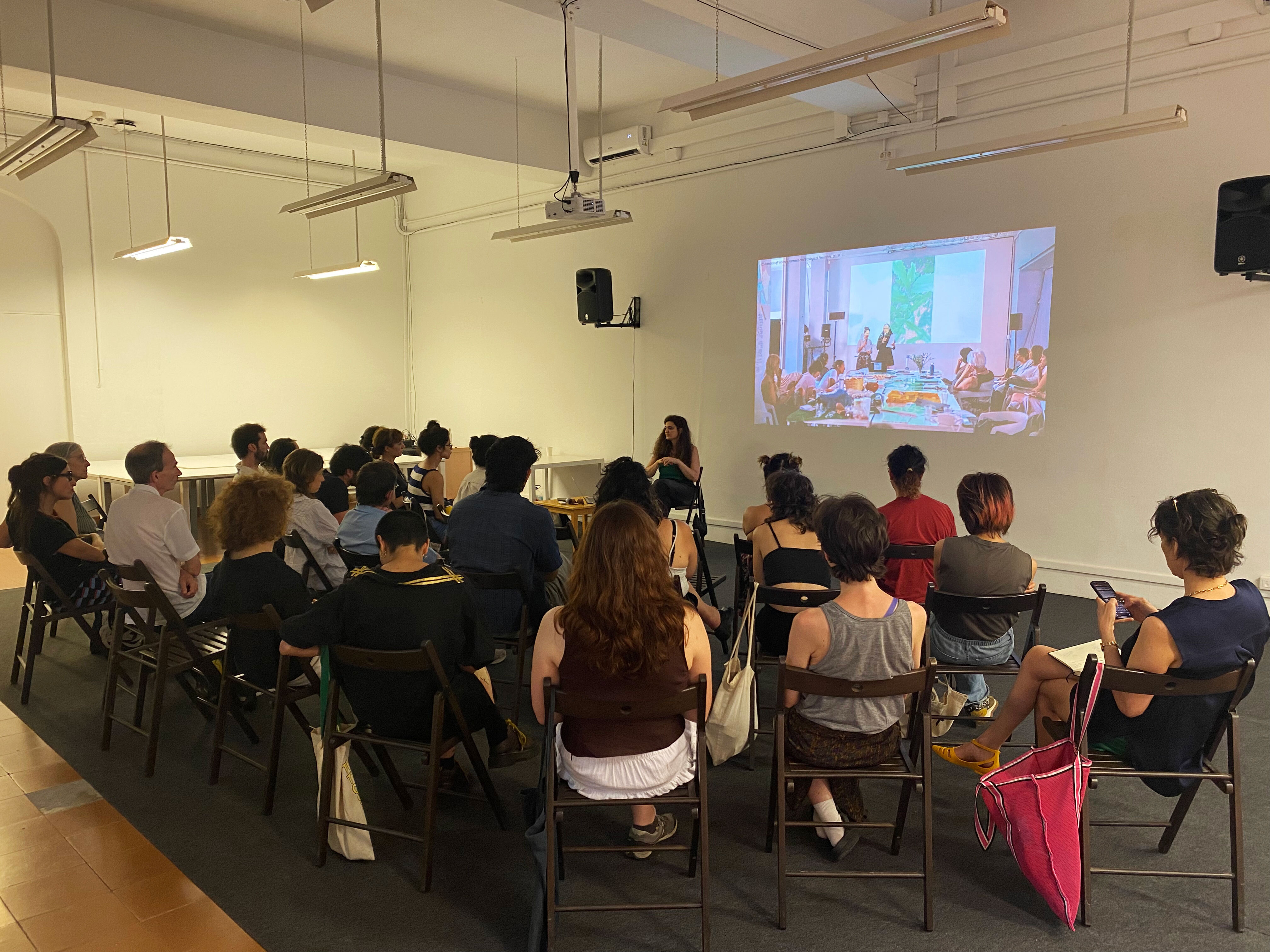
For the public talk on the 15th of July, Marwa Arsanios spoke about the different stages of her long term project Who is Afraid of Ideology? focusing on processes and methodologies of collective work. She went through the different strategies of land communalisation that she has worked with and encountered throughout the way and the role and place of film within those processes.
She reconsiders mid-20th century politics from a contemporary perspective. Her work reflects upon structural and infrastructural issues from the perspectives of new and historical materialisms alongside various feminist movements fighting for their land. Her work introduces us to the analysis of questions of property, law, economy, and ecology from their specific territorialities.
Arsanios received an MFA from the University of the Arts London (2007) and was a research fellow at the Department of Fine Arts, Jan Van Eyck Academy, Maastricht, The Netherlands (2011-2012). She has been a researcher at the Akademie Schloss Solitude in Stuttgart, Germany (2014) and at Tokyo Wonder Site, Tokyo Arts and Space (2010), and is co-founder of the 98weeks Research Project. She is currently pursuing her PhD at the Akademie der bildenden Kunst, Vienna.
Núria Güell
Tuesday the 14th of October
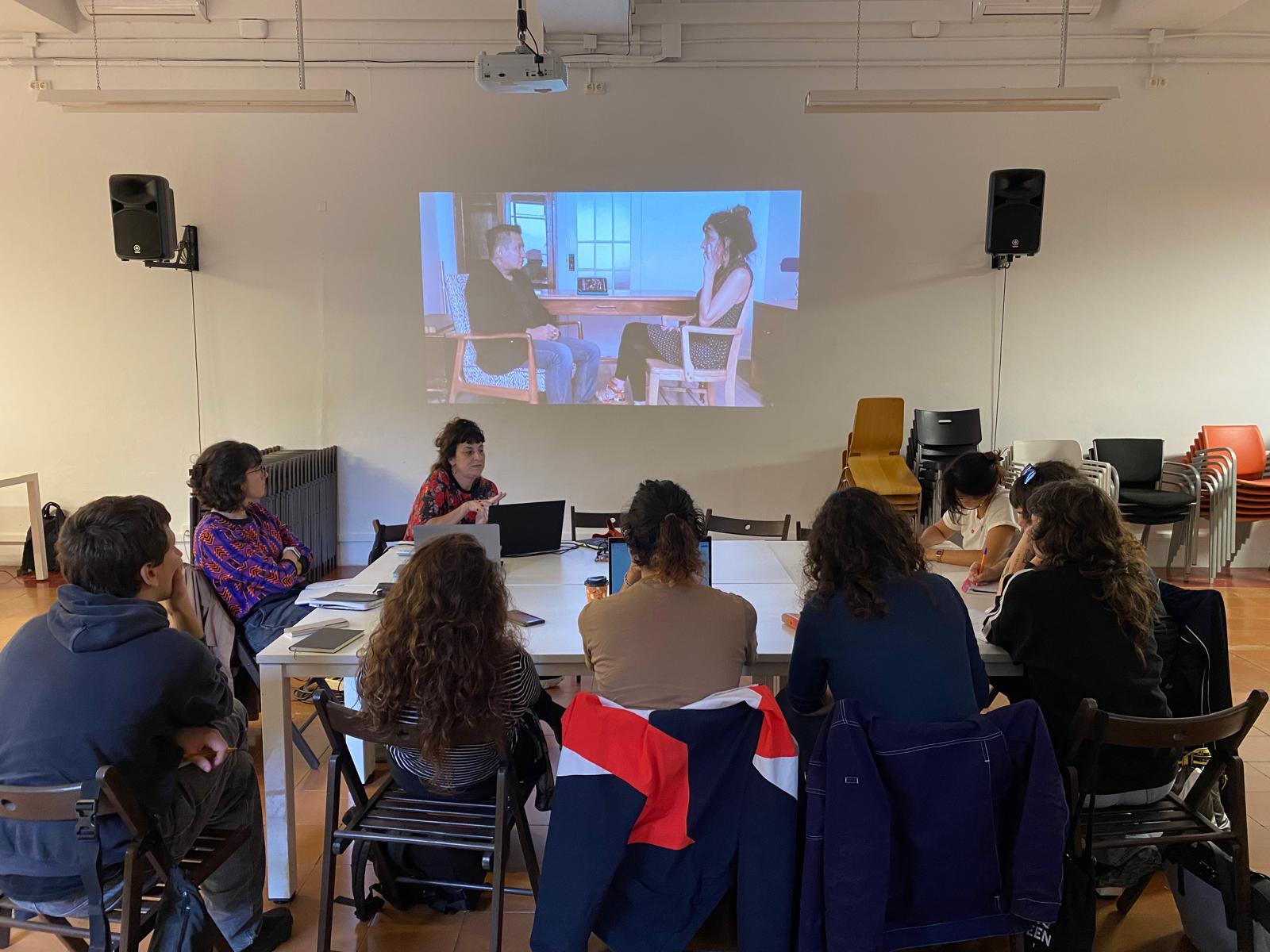
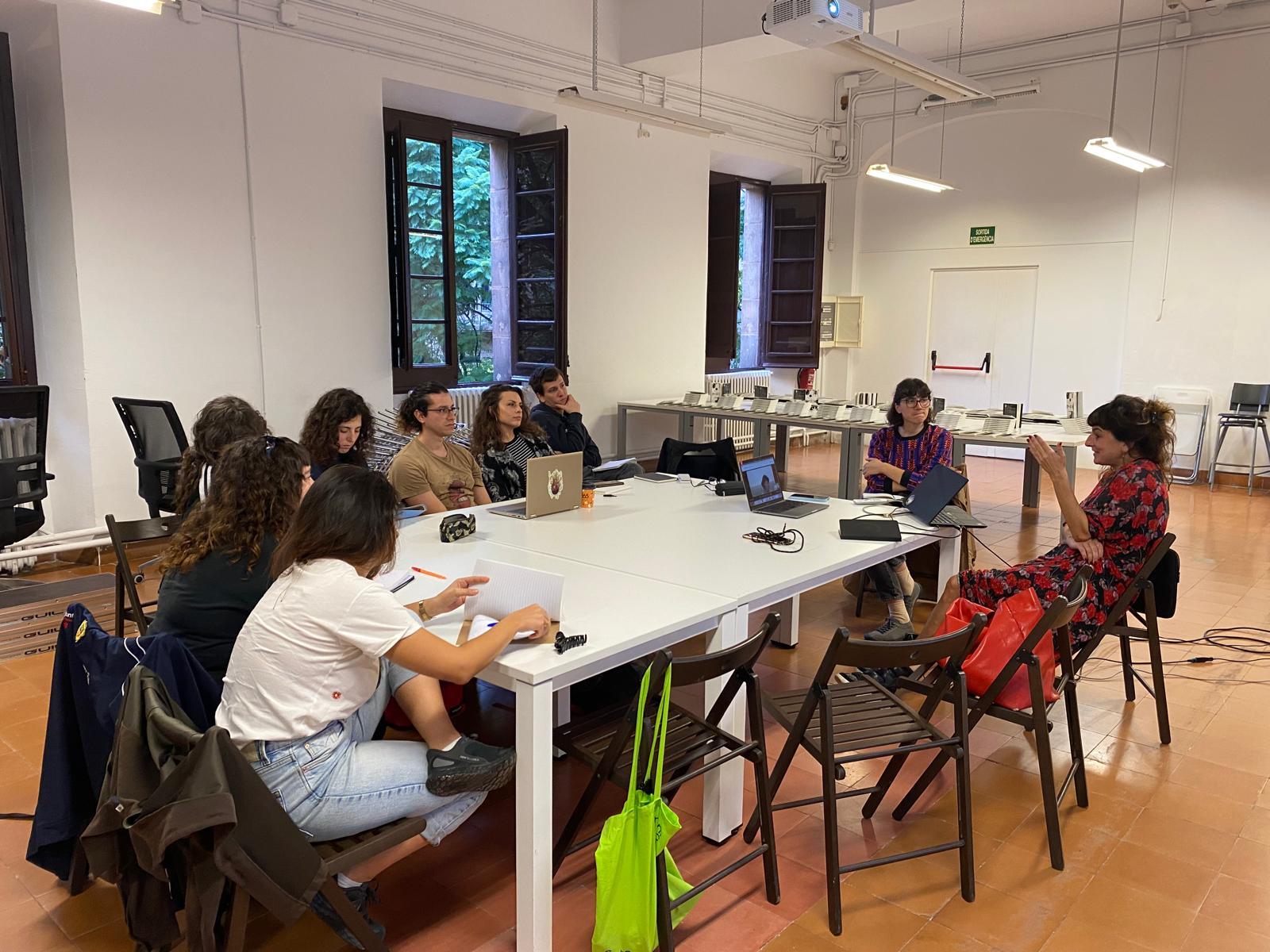
The 14th of October, we invited Núria Güell to share one of the Nosymmetries work sessions. Her idea was to connect her practice to the conceptual framework proposed in the programme. She understands her artistic practice as one of confrontation, of questioning evidence and moral conventions. For her, artistic practice is socially and politically necessary, bringing culture and the established order into play. In her group session, she shared her way of working, her internal conflicts, and what she has learn, using two of her projects as examples, ‘Una película de Dios’ 2018, and ‘Análisis sobre el discurso’ 2016. She explained that one of her objectives is to listen to those things that nobody wishes to hear, but with the subtle difference that for her, the important thing is to challenge rather than raise awareness.
Güell after graduating with a degree in Fine Arts from the University of Barcelona in 2005, she continued her studies at the Cátedra de Arte de Conducta de La Habana, Cuba. Since then, she still studies and participates in workshops, seminars, programmes, undergraduate, and postgraduate courses to the present day. She held her first public exhibition in 2005, and has since participated in about 200 group exhibitions, and 26 solo exhibitions, mainly in Europe and America. She has also received several awards and grants throughout her career, and regularly collaborates with social and educational centres.
More info: https://www.nuriaguell.com/
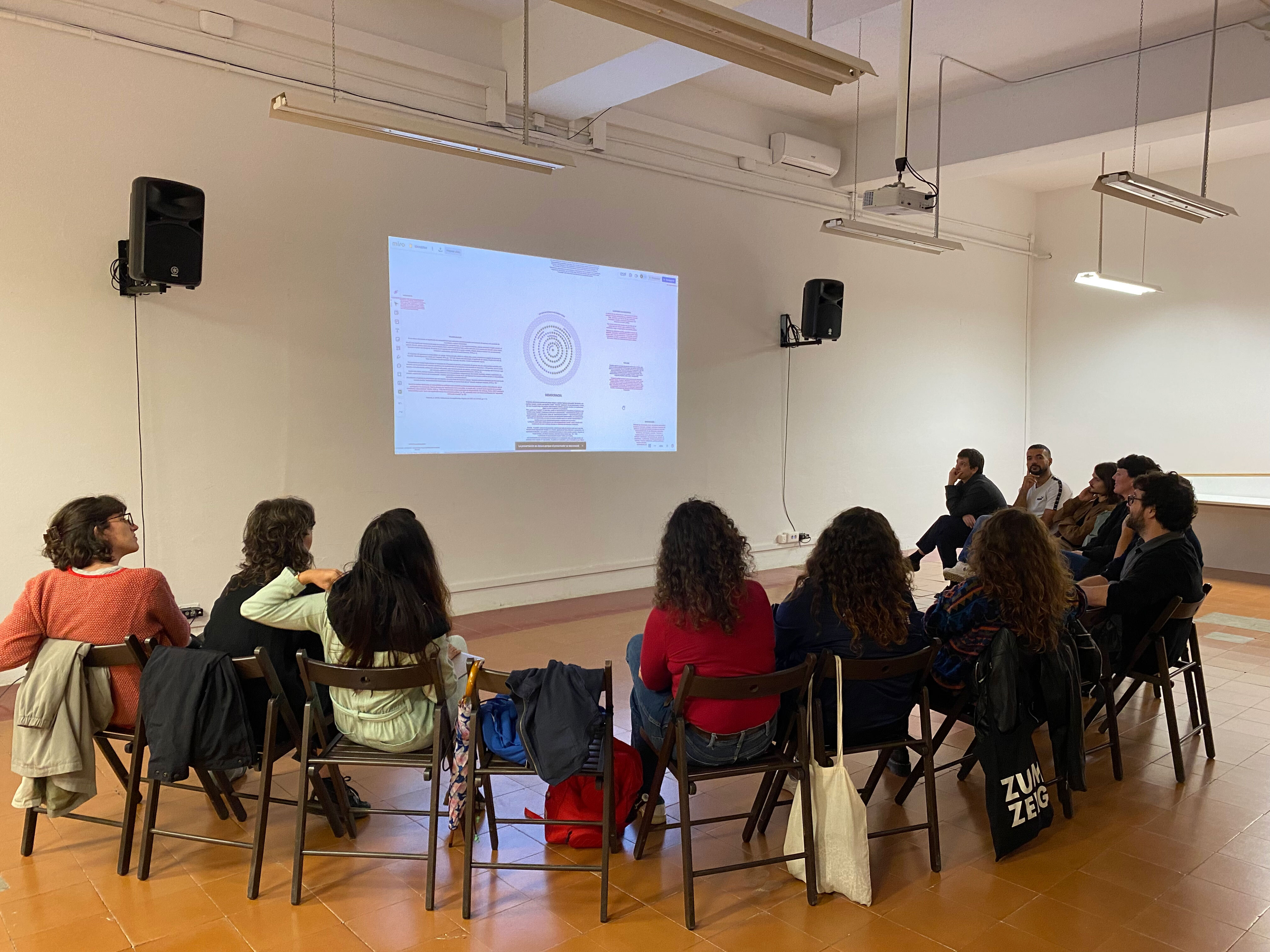
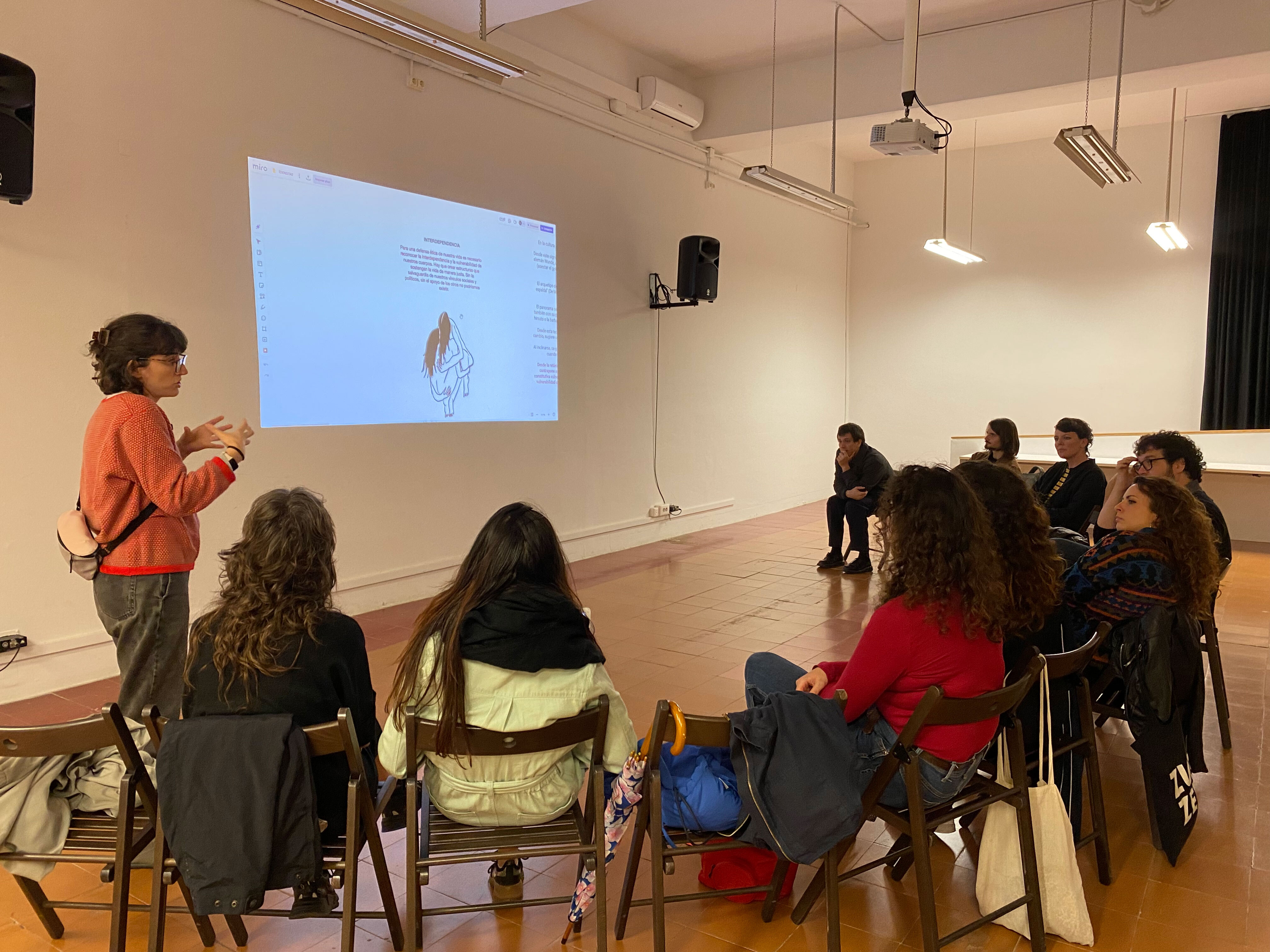
Presentation of the glossary on concepts related to the degradation of democratic values -
Open Studio Route by Homesession, La Capella and Idensitat, within the framework of Xarxaprod's 2025 Open studios
Wednesday, 29th of October
Adrian Schindler
Friday, 19th December
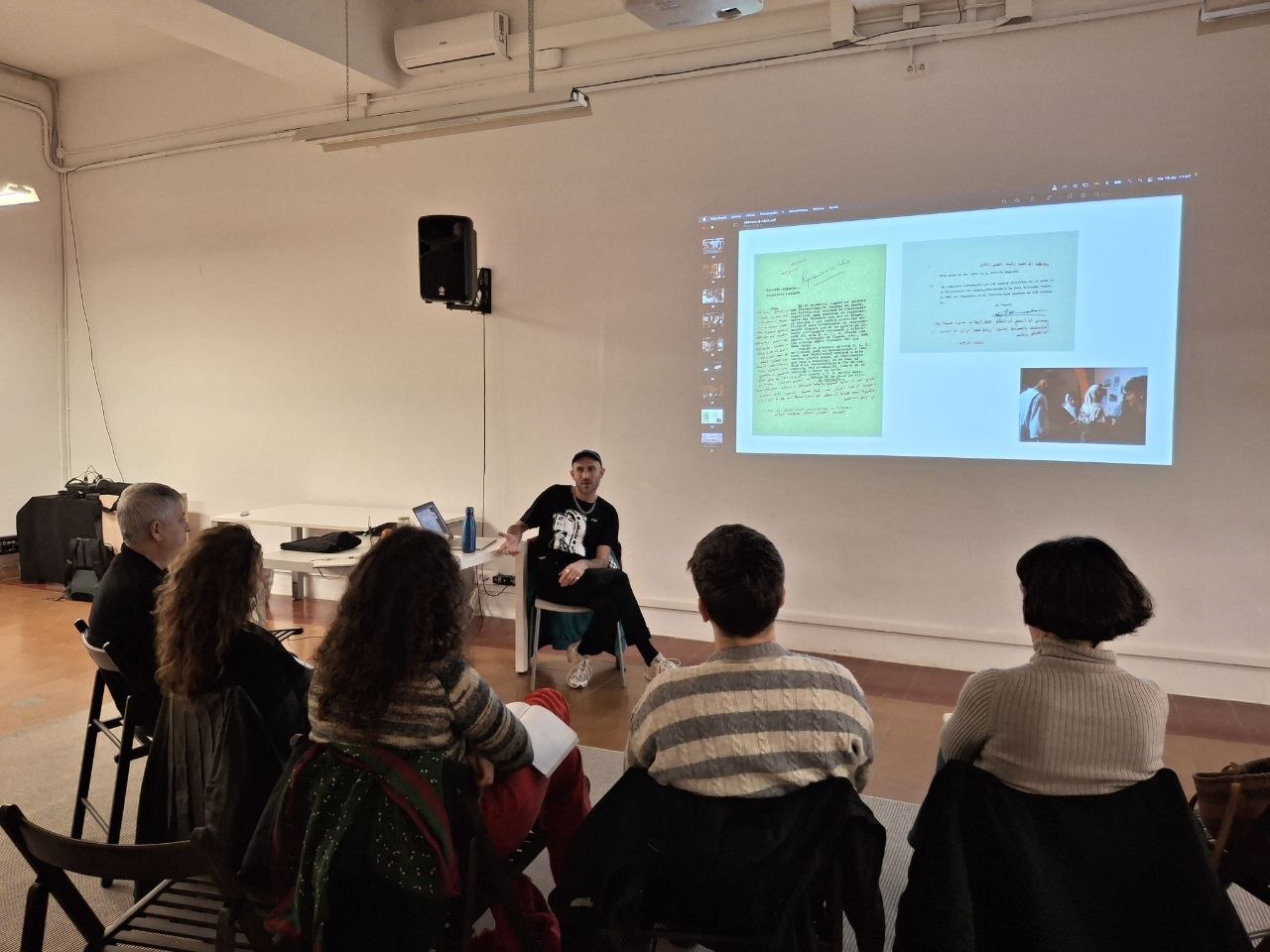
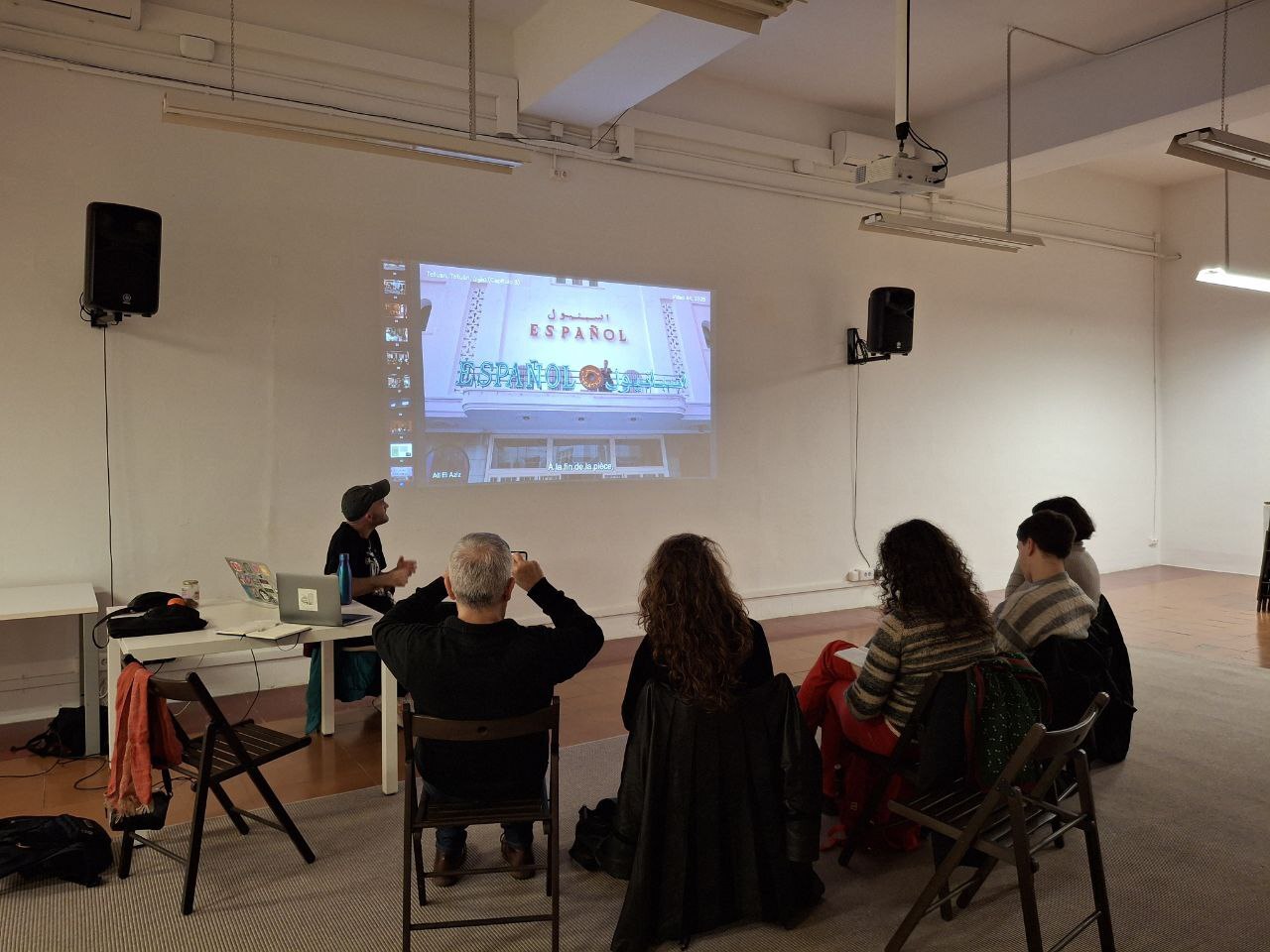
In December, we invited Adrian Schindler to share one of the Nosymmetries working sessions. Adrian talked about his career path and we viewed parts of the first, second, and third chapters of Tetuan, Tetuán, Titwan. Through his artwork, he shared with us his concern and his search for the figure of the narrator: who tells the story?. His artwork sits between biography and historical fact, and he is interested in how the past becomes present. What happens when you displace one historical onto another? What happens during that displacement? With his artwork, with his experiments, he turns the archive into a meeting place. We ended the session by sharing questions and concerns, as an example of his working methodology.
Adrian holds a MA from the postgraduate programme Art in Context at the Universität der Künste Berlin (2015), a MFA from the École Nationale Supérieure des Beaux-Arts de Paris (2012) and studied performance at the Columbia College and the School of the Art Institute of Chicago (2011). Between 2017 and 2019, he has taken part in the Research Platform and Doctoral Practice in Arts, a roaming group of art researchers hosted by different institutions in Geneva.
His latest exhibitions were at Late Idea Dice, Madrid (2024), La Casa Encendida, Madrid (2023), Collection Lambert, Avignon (2022), Fondazione Sandretto Re Rebaudengo (YCRP), Madrid (2022), MACBA, Barcelona (2021), The Green Parrot, Barcelona (2021), El Born CCM, Barcelona (2019), La Grande Halle de La Villette, Paris (2018), La Capella, Barcelona (2017), Can Felipa, Barcelona (2017), Studiolo, Berlin (2015) among others.
More information: http://adrianschindler.com/
Angelica Tognetti
She understands art as a critical and political tool which facilitates the creation of frameworks for emancipation and collective struggle. She considers it a device for enabling counter-hegemonic imaginaries which problematise the profound inequalities present in our contemporary world. Her curatorial and research projects are constructed on the basis of these convictions. Recently, having experienced first-hand the complexities of psychic uneasiness, she has begun to focus her research framework on the analysis and problematisation of the relationship between mental health and contemporary capitalism. Throughout this process, she has approached artistic practices which highlight the systemic and structural violence currently exercised on bodies affected by psychic uneasiness.
Anna Peixet i Calbet
A visual artist who makes things and a researcher into fermentation.
Her approach is a situated and responsible ecofeminism, based on the theory of intra-action
and the onto-epistemic-methodology of affections. She understands research as a porous practice which interweaves bodies, materials, and relationships - human and more-than-human -, endowing them with agencies to make visible what often is not.
In the capitalocentric inertia which we (mal)inhabit, social inequalities, violence - slow and immediate -, and care practices intermingle in a social and cultural landscape marked by the politics of fear of a capitalist and heteropatriarchal system, which accelerates a social destabilisation based on class, race, and gender difference. Artistic and cultural practices, when activated in a rensponse-able way and going beyond being a decorative ornament, can become liberating processes capable of breaking down this inertia and opening cracks of critical imagination to (re)invent and nurture possible futures.
Federica Pagano
Her research explores the potentialities of speculative design within a self-managed occupied social centre: the CSOA Officina 99, located in the neighbourhood of Gianturco - Industrial Zone in Naples. This space was occupied at night between 30th April and 1st May 1991 by a group of students, workers, migrants, and organised unemployed, a collective experience rooted in the thought and practice of workers' autonomy, which emerged in Italy in the 1970s. Through the imagining of alternative scenarios - often projected into the future - speculative design is used to create artefacts from these worlds. This design is capable of questioning the dominant reality, of revealing its prejudices and contradictions, and of provoking questions, debates and actions which open the way to alternative visions and interpretations of the present. In a global context which threatens the loss of spaces such as CSOAs - meeting spaces of confrontation between differences, of reciprocal knowledge and recognition - the research investigates the ways in which speculative design can be involved in the CSOA Officina 99 as an aesthetic-political practice, capable of exercising the collective imagination, defending the right to envision, create, and imagine alternatives and other possible worlds.
Laura Arensburg
Laura Arensburg works with moving images and bodies in movement, observing the intimate and physical connections they establish with their surroundings, exploring the transitions and contradictions of identity, perception, and contemporary power relations. This proposal arises from a need to create spaces for reflection within this genocidal political, economic, and ecological collapse. There is a sense of epochal urgency, as well as an intention to explore more rapid, situated responses than in other periods of her artistic practice. Furthermore, she believes that together we can be emotionally engaged in more profound ways.
Maria Castillejo Fernàndez
Her line of research addresses concepts such as iconolatry, neo-baroque, techno-feudalism, and epistemological decolonisation in issues such as originality and copying in artistic production. She also investigates the critical re-appropriation of the brand through iconolatry and shanzhai in a model of society which functions according to the extractivist logic of European capitalism, where the symbolic value of objects is reduced to their capacity to generate surplus value. By exaggerating the cult of consumer icons (logos, brands, media figures), we reveal their emptiness and the power structures which sustain them. It is not a question of denying their influence, but of dismantling it from within, turning the hyperbolic worship of images into a parody.
Santiago Echeverri
His lines of research revolve around migration, agency, and film, with an intersectional and decolonial approach. He seeks to combine research and action, directing his interest especially towards art, as a space in which certain forms of agency reflect collective imaginaries which may not be evident in empirical cases.
His work delves into the particularities that point to broader, often repressed, or unofficial histories, from which it is possible to oscillate between the individual and the collective.
Santiago Fernández Honrubia
He addresses the degradation suffered by the concept of ‘democracy’ in order to question this concept and to analyse the symbolic instrumentalisation of its use in contemporary politics. He finds it necessary to unravel the genealogy of Western democracies and to find their origins. His artistic practice has analysed the use of aesthetics in the field of politics from the 20th century to the present day, and how it has been a fundamental tool for the creation of the imaginary of political power.
Vanesa Peña Alarcón
Art curator, researcher, and cultural worker specialising in visual culture. Her practice is based upon conceptual and critical manifestations of contemporary art, exploring its interdisciplinary intersections and theoretical approaches. With a particular interest in expanding exhibition and performative formats, as well as in renegotiating communitarian and patrimonial practices, her work explores relationships and boundaries in individual and collective memory, with an emphasis on processes of [de]construction of meaning. In close collaboration with other artists, she develops long-term processes based on writing and knowledge transfer, adopting experimental languages which seek to expand curatorial and artistic practice.
NOSYMMETRIES 2025
Organised by Idensitat in collaboration with La Capella Center d'Art in the frame of Concèntric program. Supported by Generalitat de Catalunya, Department de Cultura.