NOSYMMETRIES / 2026-27
IDENSITAT + La Capella Centre d'Art (Barcelona)
NOSYMMETRIES is an investigative project activated through artistic processes, exploring the intersection of the concepts of social inequality, violence, and care. These issues, fueled by politics based upon threats and fear, accelerated by contemporary capitalism, directly impact upon rights, identity, gender, race, and class. and contribute to the degradation of democratic values.
INTRODUCTION
PROGRAM
WORKING GROUP
OPEN CALL
INTRODUCTION
Since 2024, Idensitat, as part of the Concentric programme at La Capella Centre d'Art, has deployed artistic practices impacting on social and cultural contexts. A working group composed of seven people will be created through this open call. A group whose participants must agree to take part in the scheduled sessions, and in the public presentation of the results deriving from them.
This initiative has been conceived as a space for sharing methodologies, for deploying processes, and for implementing projects with the aim of working towards a collective exhibition and the creation of a collective glossary. This 2026-27 edition aims to continue analysing and interrogating the concept of democracy, taking into account that we are living through a time of asymmetric growth between classes, of conflicts and polarisations, of loss of rights, of the expansion of ultranationalisms; a set of elements that converge in an accelerated degradation of life in collectivity. This line of research opened up last year by a working group and several guest artists. Their work was formalised in an exhibition entitled Vuestro orden está levantado sobre la arena. Nosymmetries.
From October to December 2026, and January and February 2027, monthly meetings will be held with the working group and with invited guests. These sessions will combine presentations, workshops, and group activities which aim to share experiences and knowledge, as well as supporting participants in defining their individual or collective project. The resulting productions will be presented in a collective exhibition open at La Capella Centre d'Art in March 2027.
Artists who wish to take part in this working group will be compensated and must submit a research and production proposal for an artistic project related to the programme's theme. Idensitat will take part in this process as promoter, mediator, and curator. Together with the guest artists, and La Capella Centre d'Art .
Artists participating in the open call will be required to communicate a working methodology and their position with regard to questioning the concept of democracy, while taking into consideration social inequality, violence, and care, fueled by the politics of threat and fear.
PROGRAM
SESSION SCHEDULE
There will be two monthly meetings, one in person and the other online. The face-to-face meeting will last all day, while the online meeting will last an hour and a half. In some of the sessions, invited artists, organisations, or cultural professionals, will intervene in the process through group workshops.
Tuesday 15th September - 10.30a.m.- 2p.m / 3p.m. - 6p.m. - Working group session (in person)
Tuesday 29th September - 4.30p.m. - 6p.m. - Working group session (online)
Tuesday 13th October - 10.30a.m.- 2p.m / 3p.m. - 6p.m. - Working group session (in person)
Tuesday 27th October - 4.30p.m. - 6p.m. - Working group session (online)
Tuesday 10th November- 10.30a.m.- 2p.m / 3p.m. - 6p.m. - Working group session (in person)
Tuesday 24th November - 4.30p.m. - 6p.m. - Working group session (online)
Tuesday 15th December - 10.30a.m.- 2p.m / 3p.m. - 6p.m. - Working group session (in person)
Thursday 17th December - 4.30p.m. - 6p.m. - Working group session (online)
Tuesday 12th January - 10.30a.m.- 2p.m / 3p.m. - 6p.m. - Working group session (in person)
Tuesday 26th January - 4.30p.m. - 6p.m. - Working group session (online)
Tuesday 9th February -10.30a.m.- 2p.m / 3p.m. - 6p.m. - Working group session (in person)
Tuesday 23rd February - 4.30p.m. - 6p.m. - Working group session (online)
Inhabiting memory, Mark Kantalinsky
This is artistic investigation, explores how architecture accumulates, transforms, and erases collective memory. The project uses the body as the main research tool for analysing the physical relationship between people and the spaces they inhabit. Using touch, movement, and direct contact with architecture, the project investigates ways by which memory is inscribed in the materials, surfaces, and textures of places, beyond stories and images. Performance here is understood not as a representation, but as a research methodology which generates knowledge from direct experience with space, materialising this knowledge in installations and video artworks.
Mark is a young Ukrainian refugee, architect, artist, and researcher based in Barcelona. His artistic practice is based upon his own experience of forced displacement and of living under military occupation. His training as an architect allows him first to approach spaces as living organisms, capable of conditioning relationships, behaviors, and collective memories, and then to develop an understanding of how these organisms are transformed in the face of processes of change, conflict, or disappearance. His work is based upon fieldwork, video, sound, cartography, and performance. He considers the body as a research tool and uses performative actions to investigate the physical and emotional relationships between people and the spaces they inhabit, transforming this research into installations and pieces of video artworks.
Maladaptive Daydreaming, Auri Alós
Investigation of the possibility of founding a fictitious state as a strategy for interrogating the material, legal, and performative conditions which make the existence of any political community possible. Starting from a childish fantasy of absolute sovereignty, the project explores political imagination as a practice capable of opening new horizons in the face of the crisis of contemporary democratic forms. The project understands fantasy as an infrastructure of reality: states, borders, nations, and democracies are also shared fictions sustained by institutions, laws, and mechanisms of recognition. Through research on geopolitics, processes of state constitution, micronations, and ambiguous sovereignties, the project questions the apparent inevitability of the political forms that organise the world, and explores other ways of imagining, constructing, and inhabiting collective life.
Auri Alós (El Prat de Llobregat, 2000) is an art historian specialising in living arts and new media, artistic researcher, pedagogue, and doctoral candidate in contemporary art theories. Her practice combines research, creation, curatorship, and mediation to investigate contemporary imaginaries and the structures that organise life in common.
Her work particularly focuses upon ways in which generation Z confronts the loss of future horizons, exploring radical imagination, contemporary spirituality, ephemeral community, and other mechanisms of escape and survival as political devices.
Tactics of opacity, Susana Rodilla
This artistic investigation explores opacity as a practice of democratic care in the face of contemporary logics of surveillance, control, and homogenisation. Through the development of a mediating device in the form of a deck of cards, the project investigates how play can become a technology of the senses, capable of making the contradictions of the present livable, and rehearsing other forms of coexistence. Inspired by Édouard Glissant's right to opacity and critical perspectives on contemporary imaginaries, the project suggests an open, transdisciplinary, and situated methodology, in which collective experimentation, non-human agency, and the shared construction of knowledge, opens up the imagination of forms of democracy based upon difference, conflict, and care.
Susana Rodilla, understands artistic practice as a process which is activated and transformed within collective contexts. Rather than producing closed objects, she is interested in building relationships, sparking conversations, and designing open devices which can be transformed through contact with other people, other knowledge, and other contexts. Her work is founded upon the conviction that methodologies are also a site of creation and that knowledge is always constructed in a situated, negotiated, and relational manner.
We sing of what we lose, Elena Sanmartín Hernández
Since 2018, Elena has been developing this line of research and creation around death and everything surrounding it. Her project unfolds through workshops, walks, conversations, and creative processes to open up collective spaces for reflecting upon the finitude of life and its rituals of mourning, attempting to restore our agency over dying.
As part of NOSYMMETRIES, she will investigate the inequalities that permeate dying and the ways in which a society supports, remembers, and bids farewell to its dead.
Elena situates her practice at the intersection between mediation, education, and artistic creation. She conceives artistic production and research methodologies as tools for critical thinking which help us to understand and confront contemporary challenges. She imagines, produces, and facilitates processes of mediation, education, and artistic creation around issues that resonate with her, such as care, grief, territory, and identity.
The body of the protest, Claudia Ventola
This artistic research analyses the kind of body which democracy assumes when it recognises the right to occupy public space. From a crip perspective, Claudia investigates the demonstration as a bodily and visual device which produces specific forms of citizenship, focusing upon the unequal distribution of police violence, and the material conditions for exercising the right to protest. Combining visual culture, political theory, and critical disability studies, the project suggests graphic reconstructions and images that make visible the relationships between body, power, and public space, understanding disability as a critical position from which to question the bodily assumptions of democratic participation.
Claudia Ventola is a visual artist, researcher, and educator. Her practice lies at the intersection of contemporary art, research, and mediation, developing projects that explore the relationships among disability, representation, anomaly, landscape, and the cultural production of value from an anti-ableist perspective. Through photography, writing, installation, sound, and archival work, she investigates how certain forms of existence are observed, classified, represented, or marginalised. Her recent work addresses issues related to fragility, difference, imaginaries of health, observation, and situated forms of knowledge production.
Democracy, bodies and affections. Raquel F. Couto
As part of NOSYMMETRIES Raquel seeks to clarify the question of What emotions are activated in the political sphere and in which ways are these emotions activated. Her objective is to develop a series of relational devices inspired by the research Lygia Clark conducted with her Relational and Sensory Objects (1960-1984): objects activated by bodily contact and body weight, designed to act as a real presence. The result of this process could trigger a set of non-human agents (objects, sound ,or tactile artifacts) designed to be activated in pairs or groups, capable of generating, even if ephemerally, a resonance and attunement between unknown bodies; that instant when the commonplace ceases to be an abstraction and becomes tangible.
Raquel F. Couto is a predoctoral researcher and artist. She understands the body, the emotions, and the common good as one inseparable fabric that permeates her artistic and research practice. In this sense, the ritual constitutes a form of knowledge in which the body is presented as a threshold, connected to that which is unseen but which leaves a trace within it. Her artwork, process-oriented and relational, is based upon bodies marked by memories and emotions which inscribe and transform them. These bodies and emotions are forces that pass through or connect the bodies, either sustaining or eroding democracy.
NOSYMMETRIES 2026-27
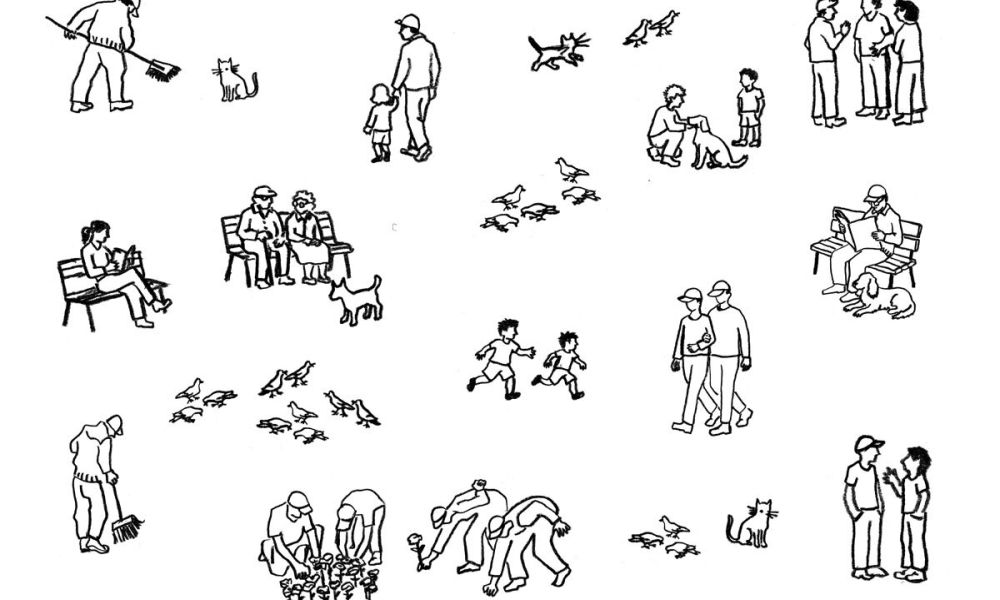
Picture made by María Kastillejof, an artist participating in the Nosymmetries 2025-26 working group
A project by Idensitat in collaboration with La Capella Center d'Art. Supported by Generalitat de Catalunya, Department de Cultura, and Ajuntament de Barcelona.