ACUPUNCTURE OF A SPACE
Jardins de Sant Pau del Camp. Barcelona, 2018–2025
A set of actions aimed at diversifying and improving the use of public space at the Jardins de Sant Pau del Camp, in the Raval neighbourhood, from a hybrid intervention perspective.
Micro-Interventions Project for Public Space / PHASE III


PHASE I / 2018-2020


Images phase I: Adrià Goula 2020
CHRONOLOGY 2018–2025
In April 2018, as a result of a commission from the Pla de Barris (Neighbourhood Plan), Idensitat submitted a preliminary project that brought together a set of ideas and proposals aimed at improving the habitability of the Jardins de Sant Pau del Camp. The proposed actions were defined through a combination of architectural micro-interventions, the development of recreational and sports activities, the configuration of new green areas, and the creation of spaces for cultural activation. Overall, the project sought to enhance the quality of the space, provide it with new uses, and re-signify it within the urban context.
The preliminary project emerged from participatory workshops and meetings between municipal technicians from the Ciutat Vella district, local organizations, and residents. In parallel, Idensitat held a series of meetings to discuss and validate the proposals put forward.
Within the framework of drafting the preliminary project, several meetings were organized and coordinated by the Directorate of Services for People and Territory (DSPiT), together with the Raval Pla de Barris, with the participation of local organizations (Xamfrà, Impulsem, CEM Can Ricart, Escola Collaso i Gil, and the community facilitator of Casal dels Infants del Raval). Two participatory sessions were also held with residents and local organizations: the first at Escola Collaso i Gil on March 15, 2018, and the second at the Jardins de Sant Pau del Camp on April 23, 2018. These sessions, attended by district councillors, consisted of presenting the lines of work proposed by Idensitat, with the aim of opening a space for discussion and gathering feedback and proposals to improve the preliminary project “Acupuncture of a Space. Jardins de Sant Pau del Camp.”
During the process, specific meetings were also held between the Directorate of Services for People and Territory and other municipal departments, including Parks and Gardens, the Conflict Management Service, the Municipal Sports Institute, the Department of Works and Maintenance, and the Urban Police.
These sessions were key to redefining the project at different stages and, above all, to specifying the priority actions to be developed in the subsequent executive project. The preliminary project was drafted by Idensitat with the participation of Ramon Parramon, Gaspar Maza, and Anna Ferrer Boltà.
In June 2018, the Ciutat Vella District commissioned Idensitat to draft the executive project, incorporating architect Inés de Rivera Marinello. Before finalizing the document, a final open citizen participation session was held on December 3, 2018, to present the definitive lines of action. In this session, the two phases into which the executive project would be divided were presented:
Phase One: play and sports area, and upgrading of the dog area.
Phase Two: participatory garden and viewing area overlooking the church of Sant Pau del Camp.
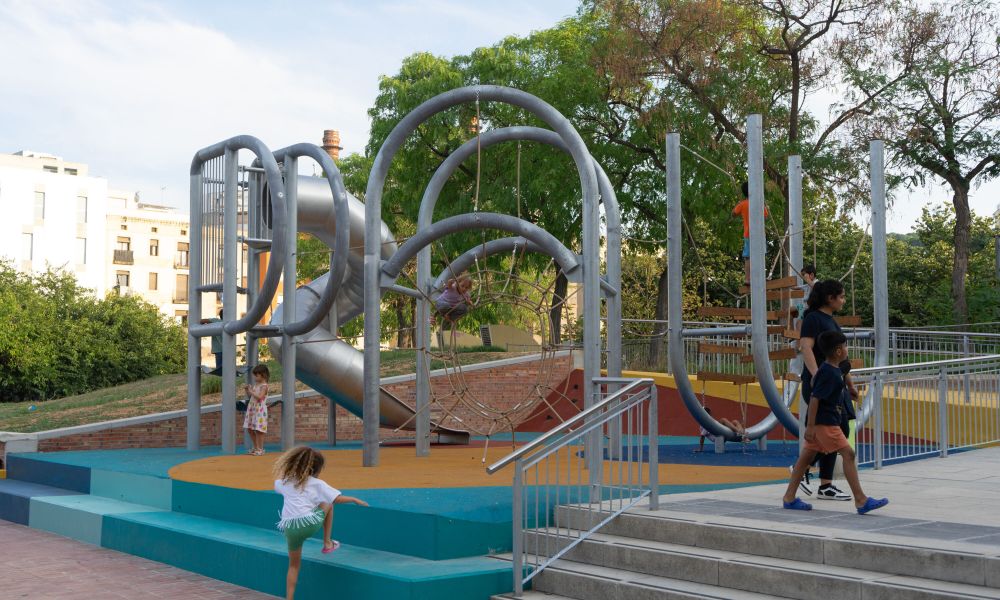
In July 2020, the park was inaugurated with the first phase completed, including a sports and play area with a pump track and a multi-use basketball court, as well as the expansion of the dog area.
Construction of the second phase was postponed, with plans to implement it in the second half of 2022, following a revision of the executive project presented by Inés de Rivera.
In September 2021, the Pla de Barris commissioned Idensitat to undertake a comprehensive reading of the space. Considering that the first phase was generating a process of regeneration in the park, the objective was to activate new improvement actions for the site as a whole.
The first phase led to a significant change in uses and the emergence of self-generated activities, incorporating new users. The second phase aimed to landscape the upper strip of the park and create a seating area that would also function as a viewing point overlooking the Romanesque monumental complex of Sant Pau del Camp.
From September to December 2021, Idensitat, together with an interdisciplinary team composed of Ramon Parramon (artist and cultural manager), Gaspar Maza (anthropologist), Azucena López (educator), Josu Andreu (architect), and Anna Ferré Boltà (architect), developed a set of ideas to continue the micro-interventions in the park. These ideas were enriched through monthly meetings with the organizations involved in the Camp de Sant Pau project: Impulsem, Xamfrà, Arnau Itinerant, Conservatori del Liceu, CEM Can Ricart, the Parish of Sant Pau, and the social activation team of the Ciutat Vella District. This work with local organizations provided an in-depth perspective on the actual uses of the space and on future aspirations for its activation and improvement.
In February 2022, the Pla de Barris and BIMSA proposed that Idensitat finalize the preliminary project in order to produce a realistic document prior to drafting the executive project. Between February and July 2022, meetings were held with various municipal departments and public space managers to assess the feasibility of the proposals and progressively adapt them to regulations and improvement objectives.
In August 2025, the park reopened to the public with the completed works, including:
Scene Space (for cultural activities)
Platform Space (play area for children aged 6 to 12)
Circuit Space (connection between different points in the park)
All micro-interventions are understood as the continuation of a process of urban acupuncture aimed at improving and diversifying the park’s uses. They are the result of a long process of analysis, negotiation, and participation by the individuals and organizations involved in the improvement and recovery of this public space in the city of Barcelona.